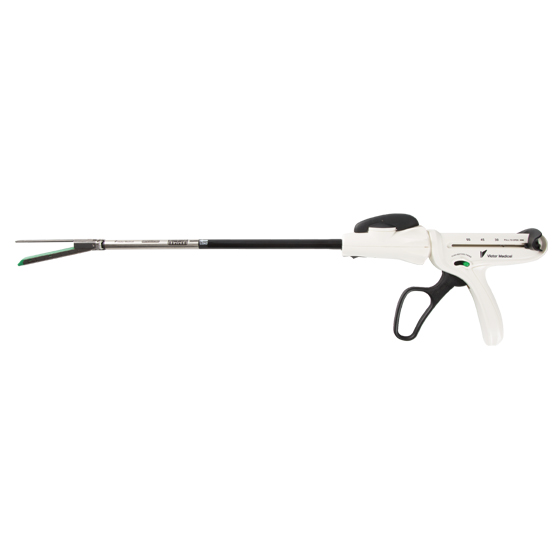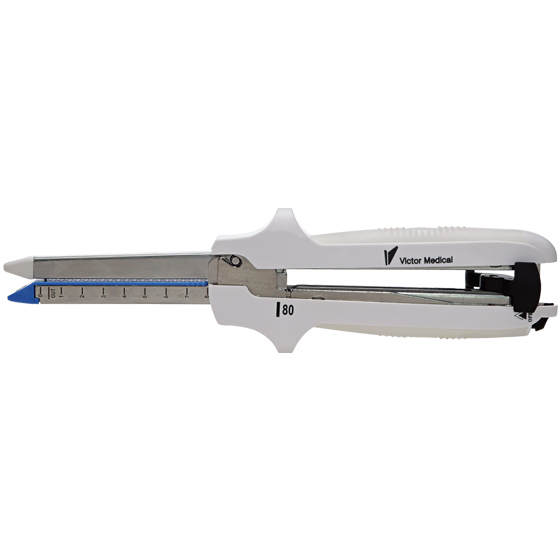


GIA linear surgical staplers can simultaneously insert three rows of cross-studded staples on both sides of the tissue, and then use a push knife to cut between the already sewn tissues on both sides, thereby cutting and suturing the tissue. The GIA surgical stapler is suitable for various surgical procedures, including thoracic surgery, general surgery, urology, obstetrics, and gynecology, such as lobectomy and gastrointestinal anastomosis.
GIA stapling device has larger jaws to help adjust the position, which helps to adjust the position. Many GIA firing button designs are operable on both sides. At the same time, the GIA linear surgical stapler is generally equipped with different lengths of staple cartridges, suitable for different GIA stapler surgeries.
Do not open the instrument immediately after firing. Keep the instrument in the closed state for 15-20 seconds to enhance the hemostatic effect.
Once the firing process is pushed to the end, there is no stopping during the firing;
Place the tissue to be fired within the scale (especially pay attention to the end of the tissue) to avoid invalid operations;
Proper use of the semi-locking device requires that the tissue to be fired is smooth without wrinkles and folds.
| Feature | TA (Single Use Linear Stapler) | GIA (Single Use Linear Cutting Stapler) |
|---|---|---|
| Primary Function | Tissue closure only (two staggered rows of staples) – no cutting | Tissue closure + cutting (two rows of staples + integrated blade) |
| Firing Action | Single‑action to deploy staples | Firing simultaneously advances the blade, cutting and stapling in one motion |
| Cartridge Design | No knife channel | Cartridge contains a built‑in blade; knife channel present |
| Operational Caution | Ensure jaw fully closed before firing | After firing, confirm the blade has fully retracted before opening the jaw to avoid tissue damage |
| Post‑Firing Check | Inspect staple line for bleeding or malformation | Inspect both staple lines and the cut line to ensure complete tissue division |

 English
 français
 Español
 italiano
 русский
 Türkçe
 português
 العربية