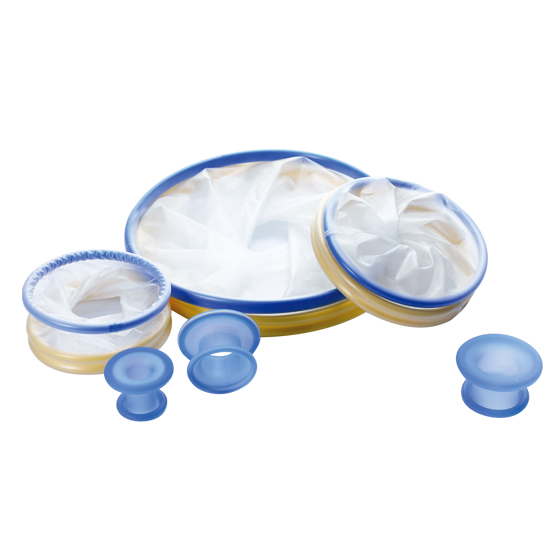


Selecting the right laparoscopic endobag requires evaluating three essential factors: bag capacity, opening design, and compatibility with the planned specimen retrieval method. A suitable retrieval bag should accommodate the specimen, allow controlled deployment and closure, and maintain its integrity during extraction.
For hospitals and surgical device distributors, capacity alone is not sufficient for product selection. Bag mouth diameter, specimen shape, material strength, trocar compatibility, and extraction-site requirements are equally important. An appropriately selected endopouch retriever helps reduce the risk of specimen spillage and supports an efficient laparoscopic workflow.
Bag capacity should be selected according to the specimen's estimated volume, physical dimensions, shape, and consistency. A bag with adequate nominal capacity may still be unsuitable if the specimen cannot pass through its opening or fit within its internal geometry.
For example, a long, narrow specimen may fit into a relatively small bag, while a firm, spherical specimen may require a larger opening even if its total volume is similar.
Before selecting a retrieval bag, surgical teams should consider:
Specimen volume: The estimated space occupied by the tissue or organ.
Specimen dimensions: The maximum length, width, and thickness.
Specimen consistency: Whether the tissue is soft, compressible, solid, or irregularly shaped.
Bag opening diameter: Whether the specimen can enter without excessive manipulation.
Closure clearance: Whether sufficient space remains to close the bag securely.
Victor Medical offers six endoscopic retrieval bag models with nominal capacities ranging from 100 ml to 750 ml.
| Model | Bag Height | Bag Diameter | Capacity |
| VERB60 | 175 mm | 60 mm | 100 ml |
| VER09 | 150 mm | 90 mm | 150 ml |
| VERB80 | 175 mm | 80 mm | 300 ml |
| VER12 | 200 mm | 120 mm | 500 ml |
| VERB100 | 175 mm | 100 mm | 550 ml |
| VERB13 | 175 mm | 130 mm | 750 ml |
These specifications are based on Victor Medical's published product information. Buyers should confirm the manufacturer's definition of bag diameter, compatible introduction port, and maximum recommended specimen dimensions before ordering.
For detailed specifications, visit the Victor Medical Endoscopic Retriever Bag product page.
Opening design influences how easily surgeons can position a retrieval bag and introduce specimens into it. A retrieval bag that opens reliably can reduce the need for repeated manipulation within a limited operative space.
Self-opening retrieval bags use an integrated support mechanism to expand the bag opening after deployment. This can make specimen placement more convenient, particularly when the available working space is limited.
Manual-opening bags require the surgeon to manipulate the bag opening using laparoscopic instruments. These designs may be suitable for procedures where sufficient working space and instrument access are available.
Victor Medical's endoscopic retrieval bag incorporates an automatic-opening design intended to facilitate deployment and specimen placement.
The mouth diameter determines whether the specimen can enter the bag without excessive compression or manipulation.
This is especially important for relatively firm specimens, such as selected fibroids or tissue masses. A bag may have sufficient nominal capacity but still be unsuitable if the opening is too narrow.
Hospitals should distinguish between bag diameter, actual opening dimensions, and the trocar size required to introduce the device. These measurements are not interchangeable.
Bag shape also influences retrieval performance. Tapered designs may accommodate elongated or flexible specimens differently from wider designs with less taper.
The closing mechanism should allow secure containment of the specimen before extraction. Procurement teams should verify the manufacturer's closure instructions and whether the bag can remain securely closed under the expected handling conditions.
The material used in an endopouch retriever must provide sufficient flexibility for deployment while maintaining adequate strength during specimen containment and removal.
Victor Medical manufactures its single use endo retrieval bags using medical-grade thermoplastic polyurethane (TPU).
TPU is a flexible polymer that can provide useful elasticity and mechanical strength for thin-film medical device applications. However, actual puncture resistance, tear resistance, and load capacity depend on material formulation, film thickness, and the complete product design.
Important material performance considerations include:
Tear resistance: The bag should maintain integrity during normal handling and extraction within its intended use.
Puncture resistance: The material must be evaluated for possible contact with surgical instruments and specimen surfaces.
Flexibility: The bag should deploy and accommodate suitable specimens without unnecessary resistance.
Closure integrity: The bag should maintain specimen containment when closed and handled correctly.
Biocompatibility: Materials must meet applicable requirements for their intended patient contact.
Importantly, flexible retrieval bags are not automatically suitable for sharp specimens. Victor Medical specifically advises against using its retrieval bag for sharp-edged tissue, such as crushed bone.
Hospitals should request applicable material and performance documentation rather than assuming that all TPU bags provide equivalent strength.
Trocar compatibility determines whether the retrieval bag can be introduced through the planned laparoscopic access port. The required trocar diameter depends on the deployment system and the device's packaged insertion profile, not simply the expanded bag capacity.
For example, two retrieval bags with similar capacities may require different access ports because their introducer structures and folded dimensions differ.
When planning specimen retrieval, surgeons should consider the complete sequence:
Select the retrieval bag according to specimen dimensions and characteristics.
Verify the minimum trocar or access-port diameter required for deployment.
Confirm that the bag can open and accommodate the specimen within the available operative space.
Determine whether the planned extraction incision can accommodate the contained specimen.
Follow the manufacturer's instructions for closure and retrieval.
The incision needed to remove the contained specimen may be larger than the port used to introduce the empty retrieval bag.
For hospitals using different laparoscopic access configurations, Victor Medical also supplies laparoscopic bladeless trocars in multiple diameters and lengths. Compatibility between the selected trocar and retrieval bag should be confirmed before procurement.
A correctly selected retrieval bag provides a containment barrier during specimen extraction, but effective containment also depends on proper handling, secure closure, and maintaining bag integrity.
Potential problems include incomplete specimen placement, accidental puncture, excessive traction, and leakage caused by damage to the bag.
Key considerations include:
The specimen should fit fully within the bag before the closure mechanism is secured. Overfilling may make closure difficult and increase stress on the material.
Sharp instruments and excessive pulling forces may compromise the retrieval bag. Surgeons should use the device according to its instructions and avoid unsupported extraction methods.
The extraction pathway must accommodate the specimen and retrieval bag. Attempting to pull an oversized specimen through an insufficient opening may damage the bag or surrounding tissues.
When malignancy is suspected, specimen handling requires additional oncological considerations. A retrieval bag does not automatically make tissue fragmentation or morcellation safe.
Any contained extraction or morcellation technique must follow applicable clinical guidance and the specific device's authorized intended use. Standard specimen retrieval bags should not be assumed to be approved containment systems for power morcellation.
Hospitals and medical distributors should evaluate both product performance and supplier documentation when sourcing disposable specimen retrieval bags.
| Evaluation Item | What Buyers Should Confirm |
| Bag Capacity | Available nominal volumes and recommended specimen characteristics |
| Bag Dimensions | Height, diameter, opening dimensions, and internal shape |
| Opening Mechanism | Automatic or manual deployment and ease of specimen placement |
| Trocar Compatibility | Minimum required access-port diameter and insertion profile |
| Material Performance | Film composition, tear resistance, puncture resistance, and strength |
| Closure Design | Closure mechanism, containment performance, and handling requirements |
| Sterilization | Validated sterilization, packaging integrity, and shelf life |
| Supplier Documentation | Applicable registration, quality certification, and product specifications |
For distributors planning bulk purchases, it is also important to confirm minimum order quantities, model availability, packaging quantities, delivery terms, and technical support.
Victor Medical offers six disposable endoscopic retrieval bag specifications, with TPU material and an automatic-opening design. This range allows buyers to evaluate different bag capacities according to surgical requirements.
For a quotation or sample evaluation, provide Victor Medical with the required bag capacity, expected specimen dimensions, preferred model, destination market, and estimated purchasing quantity. The manufacturer can then review the request against available product specifications.
Selecting a laparoscopic endobag requires more than choosing the largest available capacity. Bag opening dimensions, specimen shape, material strength, trocar compatibility, and extraction requirements all affect whether the device is suitable for a particular procedure.
A well-matched retrieval bag supports controlled specimen containment and helps reduce handling complications during laparoscopic surgery. Hospitals should evaluate the entire retrieval process, from bag insertion and deployment to closure and extraction.
Victor Medical provides disposable TPU endoscopic retrieval bags in six capacities from 100 ml to 750 ml. Hospitals and distributors can review the available models and contact Victor Medical for product specifications, sample requests, and procurement information.
It is used to contain and retrieve tissue specimens from body cavities during laparoscopic surgery.
Consider specimen volume, maximum dimensions, shape, bag opening size, and the required extraction route.
Self-opening designs can simplify deployment and specimen placement, although usability depends on the specific device and procedure.
It helps contain specimens and limit spillage when used correctly, but damaged or improperly closed bags may still leak.
No. Morcellation requires an appropriate technique and a device specifically indicated for that intended use.
Victor Medical lists 100 ml, 150 ml, 300 ml, 500 ml, 550 ml, and 750 ml disposable retrieval bags.

 English
 français
 Español
 italiano
 русский
 Türkçe
 português
 العربية