

As a professional manufacturer of staplers, we systematically compare the clinical differences between open staplers and laparoscopic staplers based on clinical practice and industry experience. This article provides a scientific reference for surgeons and procurement staff in hospital equipment departments, while acknowledging the clinical value of both device types. We present their respective advantages objectively to support safe and efficient surgery and to promote the advancement of minimally invasive surgery.
Open Stapler refers to a stapling and cutting instrument designed for traditional open surgery (large‑incision procedures). It is mainly divided into open linear cutting staplers and open circular staplers. These open surgical instruments offer a solid handling feel suitable for direct manipulation in open surgery.
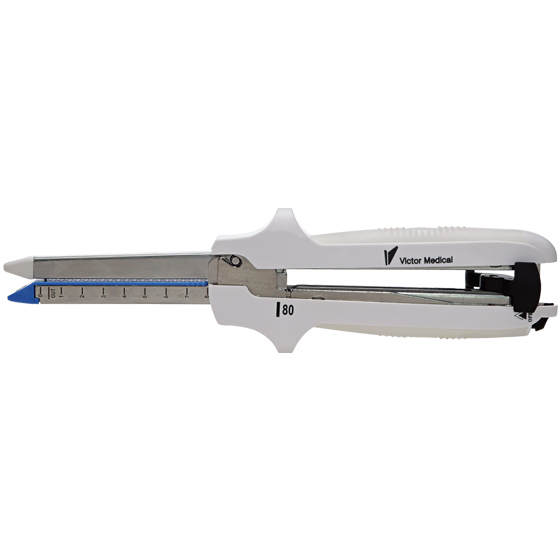
Linear Cutter Stapler: Designed for resection, transection, and anastomosis in abdominal, gynecological, and thoracic open surgeries. For example, Victor Medical's Linear Cutter Stapler features a reinforced instrument body and auto-bumped knife protector, ensuring safety and reliability during open procedures.
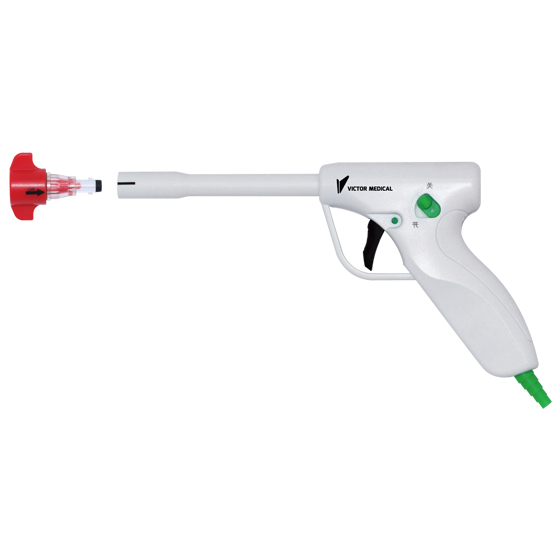
Circular Stapler: Primarily used for end-to-end anastomosis in gastrointestinal surgeries.
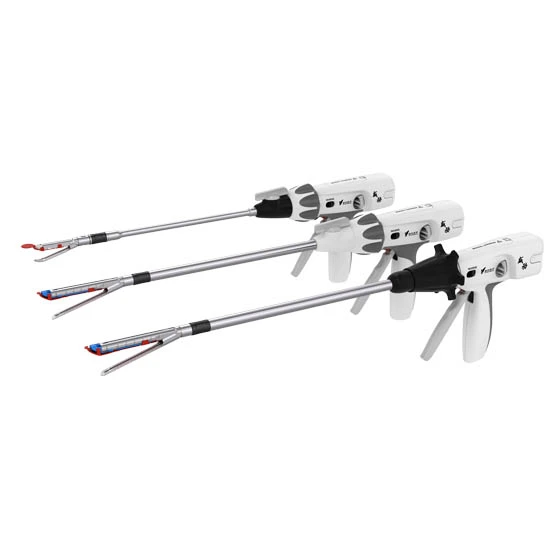
Laparoscopic stapler is designed specifically for minimally invasive endoscopic surgery. It features a slender, often articulating shaft that fits through small ports in laparoscopic and thoracoscopic procedures. It is available as laparoscopic linear cutting staplers and laparoscopic circular staplers.
Endoscopic Linear Cutter: Essential for minimally invasive tissue transection. Products like the Endoscopic Linear Cutter Stapler are engineered with varying shaft lengths (e.g., 70mm, 160mm, 260mm) to adapt to different surgical depths, from thoracic to bariatric surgery.
Powered Endoscopic Stapler: Representing the next generation of laparoscopic technology, the enhances stapling in general, bariatric, thoracic, and colorectal surgeries. Victor Medical's powered endoscopic stapler features a maximum 55° articulation angle for extreme positions in narrow spaces and a powered firing mechanism that ensures consistent staple formation, particularly useful for easier access in low rectal areas.
Both belong to the broader category of surgical stapling instruments, with core functions including tissue clamping, stapling, and cutting. However, they differ significantly in the surgical scenarios they are designed for.
Open staplers are primarily used in traditional open surgery, suitable for emergency operations, severe abdominal adhesions, large tumor resections, and other complex cases. They are widely applied in gastrointestinal, colorectal, and hepatobiliary open surgeries. Their direct manipulation and stable force transmission meet the stapling and cutting demands of complex anatomical structures.
Laparoscopic staplers are mainly used in elective minimally invasive endoscopic surgeries, such as laparoscopic radical resection of gastrointestinal cancer and thoracoscopic lobectomy. They are designed for small‑port abdominal and thoracic procedures, and are particularly suitable for obese patients, younger patients, and those with high expectations for postoperative recovery.
As minimally invasive surgery becomes more widespread, the applications of laparoscopic staplers continue to expand, while open staplers remain irreplaceable in complex and emergency procedures.
The performance and handling characteristics of both stapler types are designed around their intended surgical scenarios. The main differences lie in shaft design, operation method, and precision.
| Comparison Aspect | Open Stapler | Laparoscopic Stapler |
|---|---|---|
| Shaft design | Thicker shaft, mostly straight, firm handling feel – suitable for direct operation through large incisions | Slender shaft, often articulating, compact size – suitable for operation through small ports |
| Operation method | Surgeon holds directly, intuitive force feedback, allows flexible adjustment of clamping pressure | Operated through endoscopic instrument ports, relies on screen visualization, requires precise control |
| Precision | Suitable for large‑range tissue stapling and cutting; precision meets open surgery requirements | Fine‑tuned design enables precise operation in narrow surgical fields, reducing tissue trauma |
| Key advantages | Convenient operation, stable force transmission – suitable for complex and emergency surgery | Minimally invasive, less trauma, faster patient recovery – suitable for elective minimally invasive procedures |
From a clinical outcomes perspective, open staplers used in open surgery are associated with larger incisions, more postoperative pain, and longer hospital stays. Complications are mainly related to surgical trauma, such as wound infection and bleeding.
Laparoscopic staplers used in minimally invasive endoscopic surgery result in smaller incisions, less tissue damage, lower postoperative pain scores, faster recovery, and about 30% shorter hospital stays. The incidence of anastomotic leakage and bleeding is also lower – a key goal in our laparoscopic stapler development. Clinical data from manufacturers such as Ethicon (J&J) also show that in elective procedures, laparoscopic staplers offer significant advantages in patient prognosis. Meanwhile, open staplers, due to their more direct handling, can effectively reduce intraoperative complications in complex cases. Each device has its strengths.
Based on clinical practice and industry development, the two stapler types are not substitutes but complementary tools. Clinical selection should consider the type of surgery, patient condition, and department resources.
For elective minimally invasive procedures where patients have high expectations for recovery, laparoscopic staplers are preferred.
For emergency surgeries, complex adhesions, large tumors, and similar cases, open staplers are preferred.
Departments may reasonably stock both types to ensure full coverage.
As a surgical disposable products manufacturer, we keep pace with industry trends, drawing on technical experience from established companies such as Medtronic, to continuously improve the maneuverability and safety of our products for more complex minimally invasive scenarios. Going forward, as minimally invasive techniques become even more widespread, laparoscopic staplers will see broader application, while open staplers will continue to play an essential role in complex surgeries – together advancing the quality of surgical care.

 English
 français
 Español
 italiano
 русский
 Türkçe
 português
 العربية